
-
Communications
- Earned Media
- Advocacy & Issues Management
- Thought Leadership
- Change Management & Employee Engagement
- Training
- Interim Communications & Marketing Support
-
Creative Services
- Graphic Design
- Brand Identity
- Data Visualization & Infographics
- Creative Campaign Management
- Video Production
- Website Design & Development
-
Crisis & Issues Management
- Online War Room®
- Crisis Preparedness
- Crisis Response
- Reputation Repair
- On-Demand Crisis Consulting
- Media Coaching
- Digital Monitoring & Engagement
-
Marketing
- Paid Media
- Social Media Marketing
- Search Marketing
- Influencer Marketing
- Email Marketing
- Interim Communications and Marketing Support
- Multicultural Marketing





The Content Hive: How Helpful Content Gets Cited in AI-Powered Search
The Search Landscape Has Evolved. Has Your Content Strategy?
AI-powered search has quietly rewritten the content strategy rules. Every day, tools like ChatGPT and Gemini decide which brands show up in the answer based on content that can be verified and trusted.
Content once built for traditional search now has to perform in completely different ways. If your content can’t be cited, it won’t be surfaced. The brands showing up in AI-generated results are the ones producing content that machines can verify and trust.
This shift demands a new approach to content strategy: one that integrates Search Engine Optimization (SEO) and Generative Engine Optimization (GEO) into a cohesive ecosystem. That’s exactly the environment The Content Hive™ was made to thrive in.
Helpful content is no longer enough.
Content must be provable.
The Content Hive Framework
Effective content strategy requires more than great ideas; it requires structure, intentionality and a framework that ensures every piece of content serves a purpose.
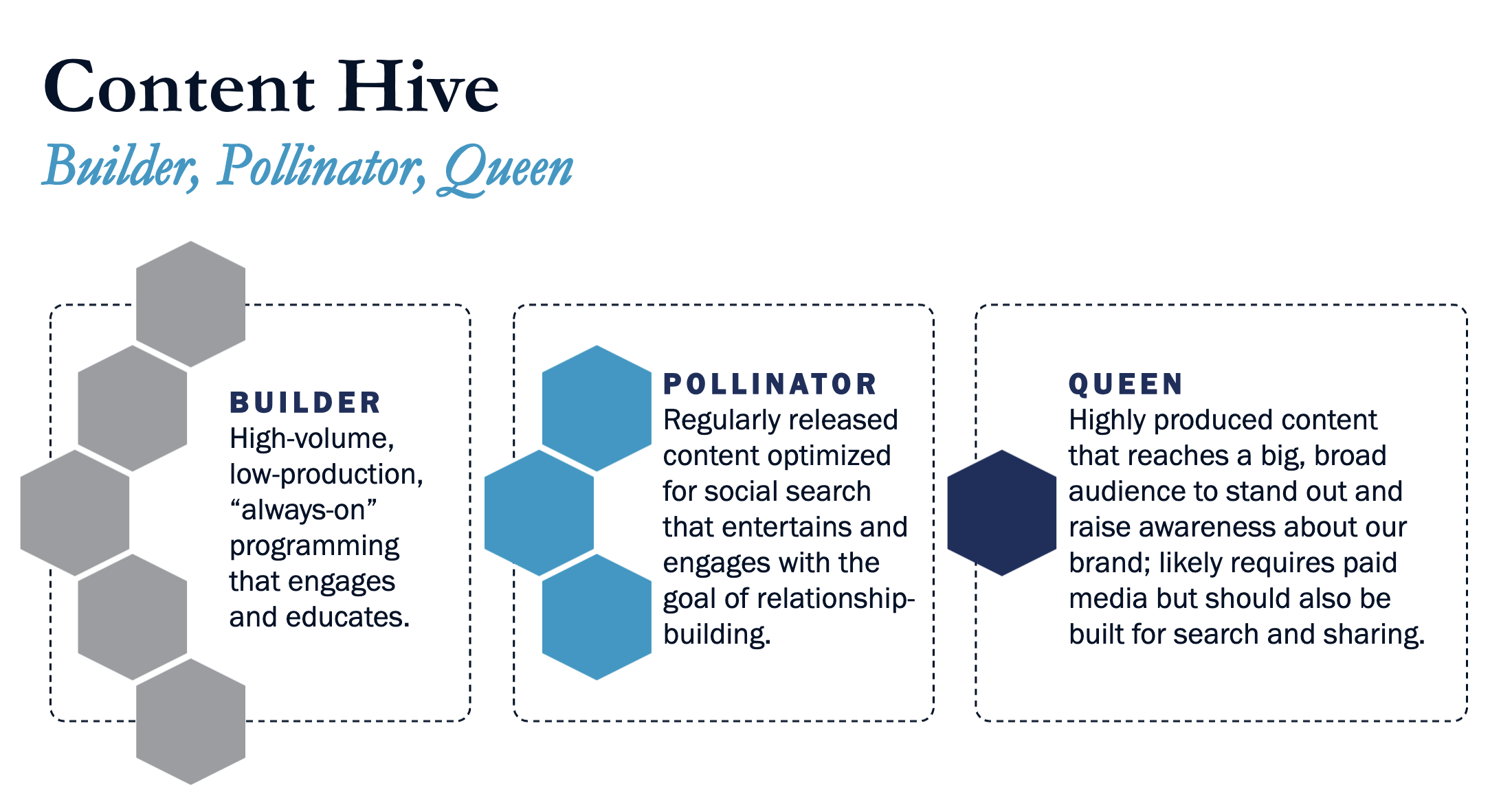
The Content Hive organizes content efforts into three distinct but interconnected tiers: Builder, Pollinator and Queen. Each serves a unique purpose while contributing to the overall health and discoverability of a brand’s content ecosystem.
- Builder content is your foundation. Web pages, blogs, FAQs and guides that stay up, stay accurate and give search engines and LLMs something reliable to point to.
- Pollinator content is what keeps you in the conversation: social posts, videos, email campaigns and timely pushes that move fast, show up across platforms and signal that your brand is active and relevant.
- Queen content is where you go big. It’s the campaign, the original research, the bold brand moment you put real weight behind paid and organic. The kind of story that earns attention, drives engagement and gets shared.
The framework serves as a foundation for thinking about content creation, distribution and optimization — ensuring that every piece of content works harder and smarter in today’s complex discovery landscape.
These three tiers also map directly to Google’s E-E-A-T evaluation criteria (Experience, Expertise, Authoritativeness, and Trustworthiness). Builder content demonstrates expertise and trust through depth and accuracy. Pollinator content signals experience and real-world engagement. Queen content drives authoritativeness by putting real weight behind the message; the kind of push that gets your brand talked about and recognized as a leader. Together, the tiers cover the full E-E-A-T spectrum.
Why a Tiered Content Framework Matters
The Content Hive emerged from a simple observation: the brands consistently showing up in search and AI results are the ones treating content as an ecosystem.
The Content Hive works as a lens to evaluate:
- What content already exists and where it connects with your audience in their journey
- Where the gaps are in the overall ecosystem
- How each new piece of content contributes to discoverability and authority
- How your content nurtures your audience’s relationship with your brand across awareness, consideration and loyalty
- Which investments will yield the greatest returns across both traditional and AI-powered search
It’s a repeatable system for planning content that performs.
The SEO + GEO Integration: A New Layer for Content Strategy
Traditional SEO focused on helping search engines find, crawl and rank your content. GEO extends this by optimizing how AI systems understand, synthesize and serve your content in conversational contexts.
When ChatGPT, Google’s AI Overview or Perplexity generate an answer, they’re trained to favor content that:
- Contains verifiable facts and statistics
- Demonstrates clear expertise and authority
- Is corroborated by other credible sources
- Provides comprehensive coverage of topics
Making content provable requires the right structure. Schema markup (Article, FAQ, HowTo, Organization) provides context to machines and bots, giving search engines and LLMs explicit signals about what your page contains and who created it. Structured data is one of the most direct bridges between SEO and GEO.
Citation architecture matters too. Content that AI can easily cite follows a pattern: clearly sourced claims, linked references, pull-quotable statistics and structured assertions with attribution. The easier it is for an AI system to extract and attribute a fact to your brand, the more likely it is to do so.
A tiered content framework like the Content Hive addresses these requirements at every level, which is why this approach is becoming essential for modern content strategy.
The easier it is for AI to cite your content, the more likely your brand is to show up in the answer.
The Bottom Line: Helpful Is No Longer Enough
Google’s shift toward helpful content signals raised the bar for what it means to genuinely serve user needs. But in an AI-augmented search landscape, being helpful means being provable.
The Content Hive framework provides the structure needed to create content that:
- Ranks in traditional SERPs
- Appears in AI-generated summaries and overviews
- Gets cited by LLMs as authoritative sources
- Builds lasting brand authority across all discovery channels
Your builder content creates the foundation of provable insights. Your pollinator content spreads and reinforces your authority. Your queen content establishes you as the definitive source in your space.
Together, they create a content ecosystem that thrives in both the search engines of today and the AI-powered discovery systems of tomorrow.
Is Your Content Built for AI Discovery?
Most brands don’t know how visible — or invisible — their content is to AI-powered search. That’s where we come in.
GroundFloor Media’s Answer Engine Assessment evaluates how visible, citable and authoritative your brand appears across search and AI-powered platforms and gives you a clear roadmap using the Content Hive framework for what to fix first.
Ready to find out where you stand? Let’s talk.